 Free quote
Free quote
Free quote
Fulton County
Permanent LED, landscape and commercial lighting in Alpharetta, GA — downtown, Avalon corridor businesses and north Fulton residential streets.
Alpharetta is two markets sharing a name. There is a large, established residential base across north Fulton, and there is a commercial district — the downtown blocks, the Avalon corridor and the office campuses along the 400 spine — where the standard for exterior lighting is set by developments with a professional lighting budget. Both are good work, and they are not the same job.
Bridges Lighting Pros installs permanent LED lighting, landscape lighting, holiday lighting and commercial lighting across Alpharetta. Call (770) 630-4653.
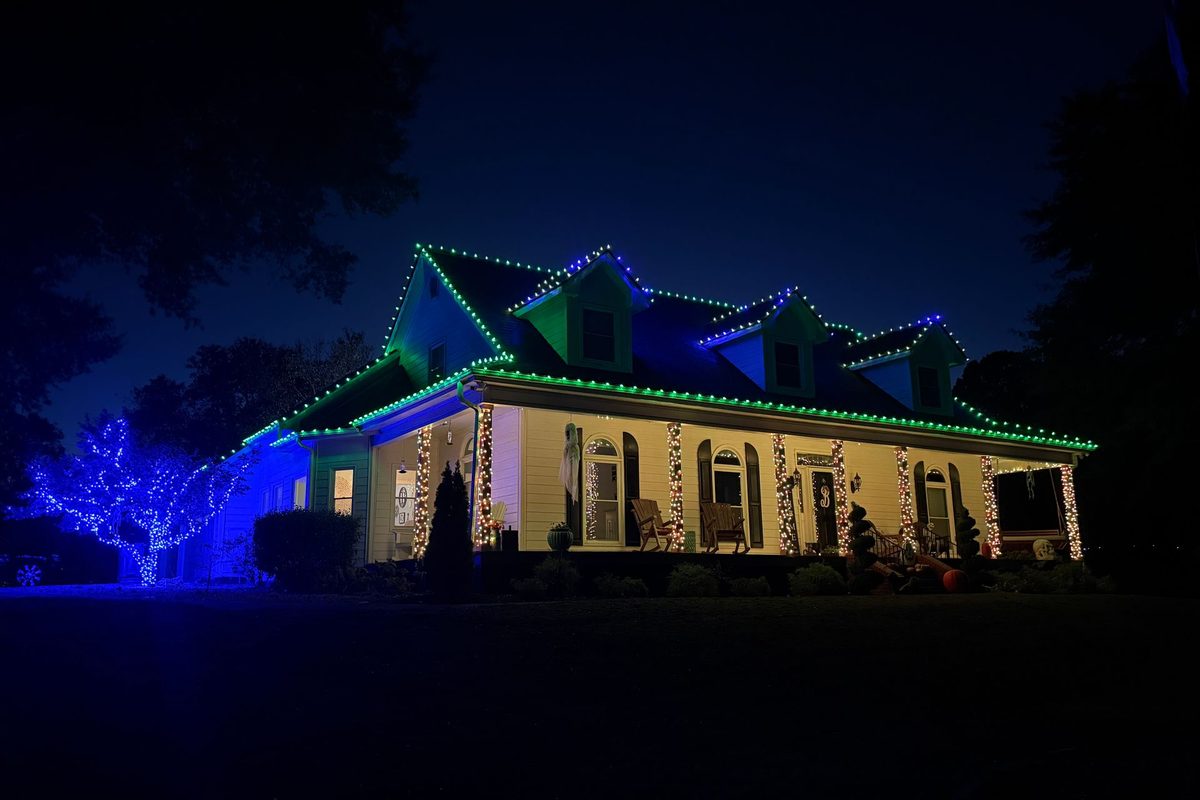
The mixed-use developments here have raised what a lit building is expected to look like locally, and an independent restaurant or storefront a few blocks away is judged against that. A dark facade on a street where everything else is lit does not read as understated, it reads as closed.
For commercial properties the specification differs from residential in three ways. Zones get separated — building, entrance canopy, signage band, patio — so each can run at its own level and schedule. Brand colour has to be reproduced accurately rather than approximated, which is an addressable-LED and controller question. And daylight appearance matters more than on a house, because a customer stands three feet from the hardware rather than seeing it from the road.
Patio and bistro lighting is frequently the higher-return half of the job for restaurants here. A patio that fills after sunset is worth more per year than a lit parapet.
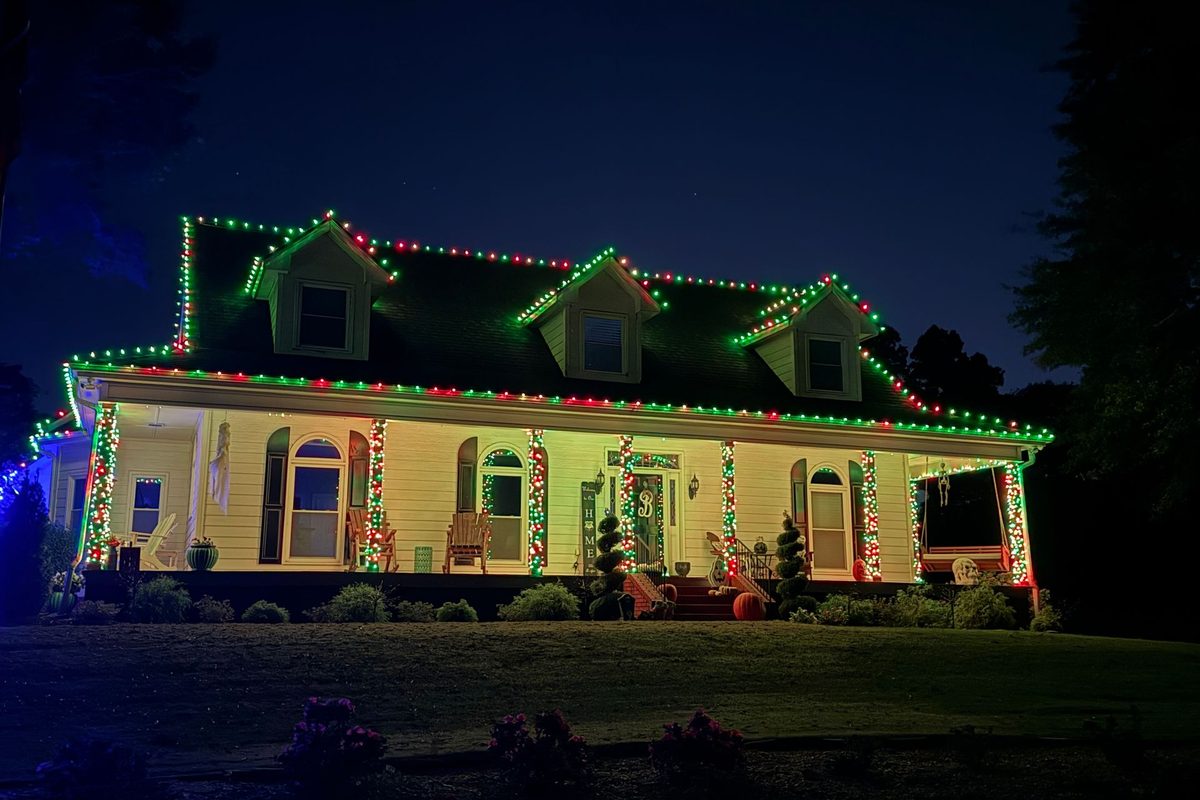
Alpharetta's housing runs from established 1980s and 90s neighbourhoods with mature canopy through to newer infill and larger custom homes toward the Milton line. The design questions follow from that: houses with regular rooflines and open front elevations take roofline lighting well and quickly, while heavily treed lots and complex custom roofs need editing and usually benefit more from landscape work.
Downtown Alpharetta's older streets are a third case — smaller, closer-set houses with more architectural detail per elevation, where lighting the porch, the columns and the front planting often beats a roof edge.
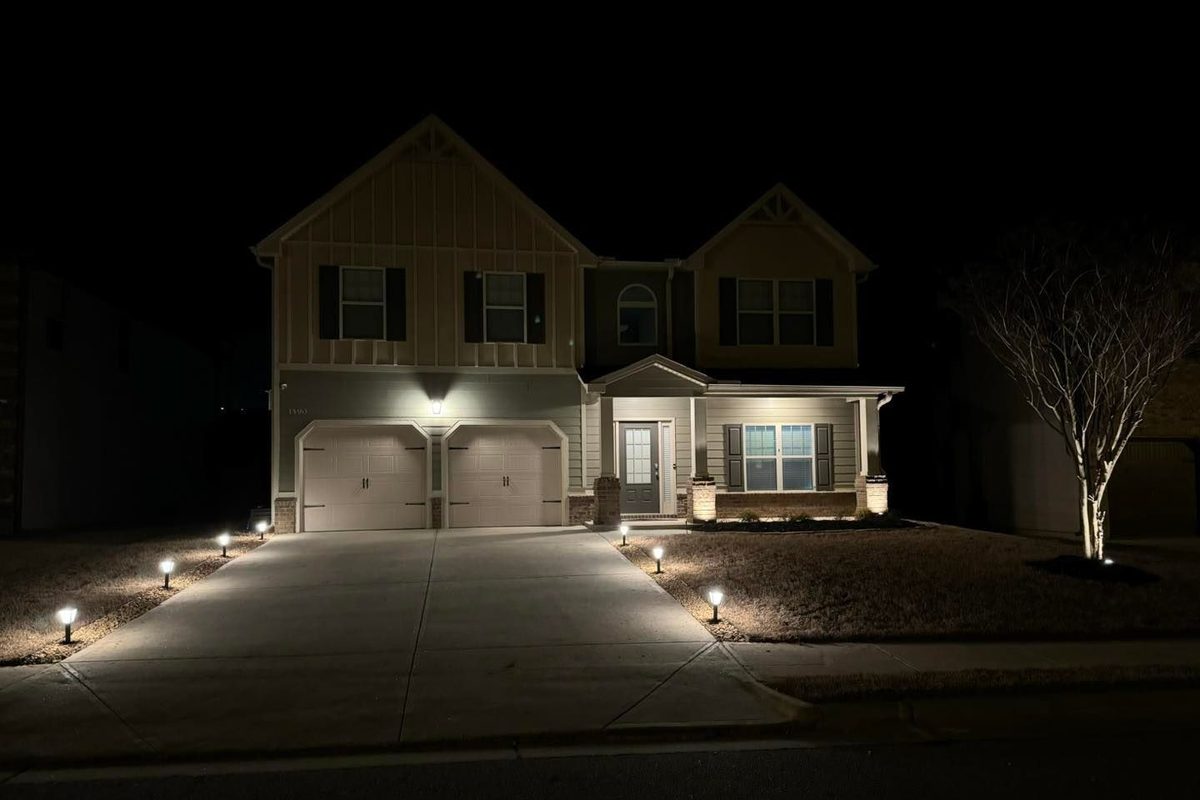
Alpharetta books early. Holiday installations should be arranged in October or early November, and commercial holiday work earlier still, because a retail or restaurant property wants lighting up before its own season starts rather than in the middle of it.
Our seasonal work runs as a lease — we own the lights, install from October, service anything that fails through December 23rd within 24 hours, take down from January 1st and store everything. For a business that means no inventory, no storage, and no staff member in charge of a box of strands.

Services
Nearby
Questions
Yes, and it is worth doing as one job. The anchors, the power runs and the control system get planned once instead of twice, and the patio and building end up on the same schedule rather than being switched by different people at different times. Splitting them into two projects a year apart usually costs more and produces a less coherent result.
Yes. Monument signage, entry columns, and the landscape around them, on a schedule, under one arrangement rather than as an amenity nobody on the board wants to own. Permanent lighting at an entrance also covers the holidays without an annual install-and-remove contract.
Per property, after a site walk. The drivers are total linear feet, number of zones, mounting surface and access — a single-storey retail fascia and a multi-storey building with a parapet are different jobs at similar footage. On multi-tenant properties we need to know who is authorising the work and which elevations are in scope before designing anything.
Yes, and for a commercial property that is most of the value. A permanent system is controlled rather than switched, so it can hold brand colours through the year and change for a date without anyone going up a ladder.
The practical setup is an astronomical schedule — on at sunset, off at a set hour — with saved scenes for the handful of occasions a business actually wants something different. For a retail or restaurant tenant that tends to be the holiday period, a local team's colours, and whatever the landlord's calendar requires.
Zoning matters more on commercial than residential. Being able to light the entrance and signage while leaving the rear elevation dark is what keeps the running cost and the neighbour complaints down.
Usually more people than a homeowner expects, and it is worth establishing early because it sets the timeline rather than the price.
On a leased unit it is typically the landlord or the property manager rather than the business occupying it, and many retail and mixed-use developments here run their own design standards covering anything attached to the building or visible from a shared area. A tenant improvement allowance may or may not cover exterior lighting.
None of that is an obstacle, but discovering it after a date has been promised is how installs slip. The first question on a commercial quote is who has to approve it, not what it costs.
Yes — Alpharetta, Milton, Roswell, Johns Creek and the surrounding north Fulton communities, along with Gwinnett to the east. Call (770) 630-4653 to arrange a site visit or a commercial site walk.
The second one is a decision about restraint. A building lit evenly all over reads as a building at night. A building where the entrance, the sign and one architectural feature are lit, and the rest is left dark, reads as deliberate.
For a commercial property that distinction is most of the value, because it is what makes a unit look open and cared for from the road at six in the evening in January. Lighting everything costs more and achieves less.
Yes, provided the first phase is designed with that in mind — transformer capacity and cable routes are the things that get expensive to change afterwards.
Specifying slightly more capacity than the first phase needs costs very little at install and makes a later addition a straightforward job rather than a partial rebuild. It is worth raising at design even when there is no immediate plan for a second phase.
Approval timelines in managed developments run to weeks rather than days, so the paperwork is worth starting the moment a design is agreed rather than once a date is wanted.
Get in touch
Call and talk to someone who does the work, or send the details and we'll get back to you.
Call (770) 630-4653