 Free quote
Gwinnett County
Brass facade, porch and path lighting in Lawrenceville, GA — from the older homes near the square to the newer subdivisions. Designed on site after dark.
Lawrenceville is the county seat, and it has two very different kinds of residential street. Close to the historic square there are older houses with deep front porches, columns, gables and real trim. Further out, most of the city is subdivisions built over the last thirty years, where the garage faces the street and the landscaping is still catching up with the house.
Bridges Lighting Pros installs solid brass landscape lighting across Lawrenceville — facade grazing, porch and column lighting, path and step lighting, and uplighting on trees. Call (770) 630-4653.
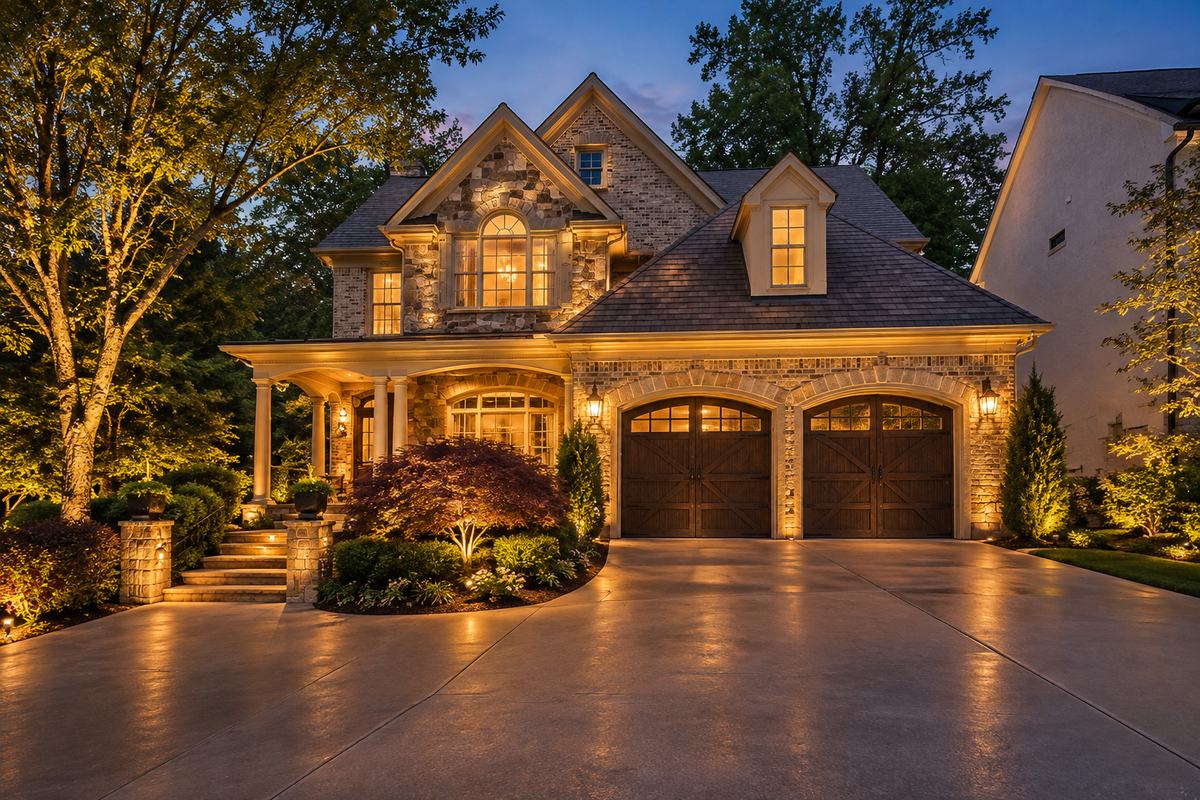
On the in-town houses, the house itself is the subject. A porch with columns, a gable with detail, a brick chimney — those are the features that disappear at night, and they are exactly what low-voltage lighting is good at bringing back.
The method is different from lighting a tree. Columns want a narrow beam from a fixture set close to the base, so the light runs up the shaft and stops at the capital instead of spraying across the porch ceiling. Brick and stone want grazing: a fixture tight to the wall, aimed almost straight up, so the light skims the surface and every course shows its texture. Painted clapboard wants the opposite, a softer flood from further out, because grazing lap siding just exaggerates every shadow line between boards.
The aim is to light the parts of the house worth looking at, not the whole wall. An evenly lit facade looks like a car dealership. A few columns, the entry, and the corners of the house, with darkness in between, look like a house someone cares about.
On a house with a real front porch, people sit out there after dark, and the lighting has to work from the porch as well as from the street.
That means no fixture aimed so that it shines into the eyes of whoever is sitting on the swing. Uplights on the columns are set and shielded so the source is below the rail line. Light on the front walk stays low. If the beds in front of the porch have shrubs or ornamental trees, a couple of small fixtures on those give the view from the porch a foreground instead of a black yard.
In the newer neighbourhoods across Lawrenceville, the most common problem after dark is simple: the brightest thing on the front of the house is the garage, because that is where the builder put the coach lights.
Landscape lighting fixes that by moving the attention. A wash across the front entry, uplights on the two or three trees the builder planted, and path lighting along the walk pull the eye toward the door and away from the garage doors. It is the cheapest structural change you can make to how a front-load-garage house reads from the street, and it does not involve touching the house.
On these lots the trees are often still young. We light what is there now and size the system so fixtures can be added or moved as the trees grow, rather than pretending a ten-year-old maple is a specimen tree.
Lawrenceville has a lot of sloped lots, and a lot of front walks that leave the driveway and climb to the door. That walk is the one place on the property where lighting is about safety first.
Path lights belong at the edges and the turns, not marching in a straight line down both sides like a runway. Steps get light on the risers, or a low fixture set to the side, so the edge of each step is visible without anyone looking into a bulb. Where a walk crosses a grade change or a short retaining wall, that is where the light goes first.
Everything we install is solid brass, wired low-voltage at 2700K warm white.
On an older house the brass matters for a reason beyond longevity. Brass weathers to a dark brown that disappears into a bed within a season or two, so the fixture stops being visible in daylight. Aluminium fixtures with a powder coat stay glossy until the coating fails, and then they corrode. Next to a hundred-year-old porch, a shiny black plastic-looking fixture is the thing everyone notices.
Warm white is the other half. Cool light makes old brick look grey and painted trim look blue. At 2700K, brick reads as red, wood reads as wood, and the house looks like it did when it was built — just after sunset.
Christmas lighting is popular here, especially on the porch houses near downtown, where the architecture gives you more to work with than a roofline. Garland and lights on the porch rail, wreaths on the columns and the gable outlined usually look better on an older house than a full outline of every eave.
We also install permanent eave lighting, and it suits some of the larger two-storey houses in the newer subdivisions, where the roofline is high, long and clearly visible from the street. On a single-storey house close to the square, it is usually the third thing we would suggest, after landscape lighting and a good holiday design.
Services
Nearby
Questions
Yes, and on closer-set in-town lots it is part of the design. Fixtures aimed at the house, not across the property line, with shielded heads and the narrowest beam that does the job, keep the light where you want it. We check sight lines from the street and from the house next door at the dusk visit.
Not usually. The better move is to balance them. Once the entry, the trees and the walk are lit, the coach lights stop being the only thing on the front of the house. Some owners swap in a lower-wattage warm bulb afterwards so the garage is no longer the brightest point.
We come out around sunset, walk the property with you, and look at it as it gets dark — which features matter, where the sight lines are, where the power is. The person who designs it on site is the person who installs it.
Yes — in-town Lawrenceville, the subdivisions on every side of it, and the neighbouring communities like Dacula, Grayson and Snellville. We are based in Loganville, a short drive down the road, which matters for the follow-up visits where a landscape system gets re-aimed as the plants grow.
Call (770) 630-4653 to book a dusk walkthrough in Lawrenceville.
Get in touch
Call and talk to someone who does the work, or send the details and we'll get back to you.
Call (770) 630-4653