 Free quote
Gwinnett County
Brass landscape lighting in Sugar Hill, GA. Rolling lots, retaining walls, stepped grades and long uphill cable runs — designed on site, aimed after dark.
Sugar Hill has spent the last decade turning a crossroads into a downtown, and the residential land around it does something no other town on our list does quite as much: it moves. The lots roll, the driveways climb, the yards step, and almost every house sits above or below the road rather than level with it.
That terrain is the whole story for landscape lighting here. Bridges Lighting Pros installs solid brass low-voltage systems across Sugar Hill — call (770) 630-4653.
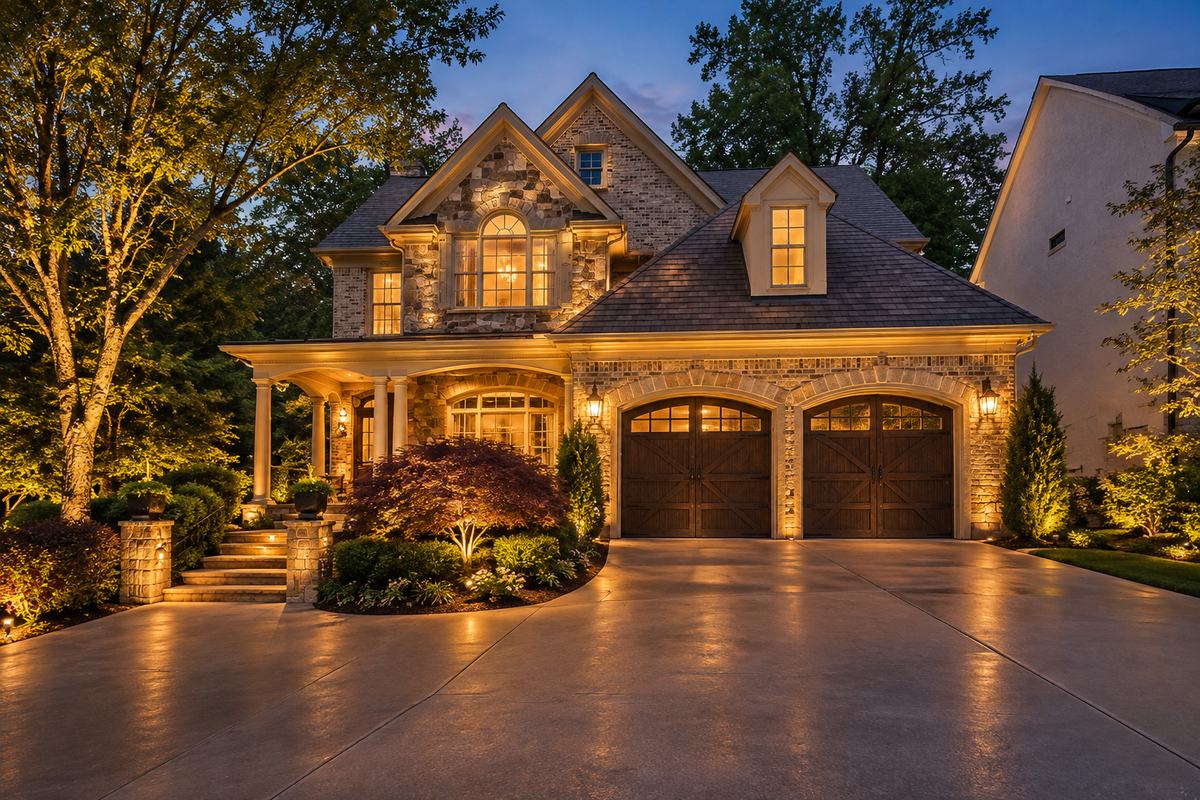
On a flat lot you light objects. On a Sugar Hill lot you light levels.
A house set eight feet above the street is seen from below, which means uplighting carries much further than the designer expects and the roofline barely reads at all. A house set below the road is seen from above, so downlighting from trees and lighting the top surfaces of walls and steps does the work, while ground-level uplights aimed back toward the road throw glare straight into a driver's eyes.
The first question on a sloped property is therefore not what to light but from where it is seen. We walk it at dusk from the street, from the driveway, from the front door and from whichever window the family actually sits at, because those four viewpoints frequently want four different answers.
Sugar Hill is full of retaining walls — segmental block, stacked stone, poured concrete — because that is what building on a grade requires.
A wall is the best value in landscape lighting and the most commonly ignored surface on a property. A low fixture set a foot or two off the face, grazing light almost parallel up the wall, turns a flat block surface into texture and shadow. On stacked stone it is dramatic. On plain grey block it is the difference between an engineering feature and a designed one.
Where a wall has a cap, integrated lighting under the cap lip washes down the face and lights nothing else, which is the cleanest result available and completely invisible by day. It has to go in with the wall or be retrofitted carefully, so it is worth raising early if a wall is being built.
Every stepped front yard here has at least one flight that goes dark.
Step lighting is not decorative. A single riser you cannot see, at the bottom of a flight, on a wet night, is how people fall. The fix is low fixtures set into or beside the risers, aimed at the tread ahead, with nothing at eye height. Light the top step, the bottom step and any landing or change of direction — you do not need every riser lit, you need the transitions obvious.
Where steps run through a bed, low path fixtures set behind the planting light the steps indirectly and keep the fixture itself out of the sight line.
Sloped lots make cable runs long, and long runs are where cheap landscape lighting quietly fails.
Low-voltage cable loses voltage over distance. On a two-hundred-foot run with undersized cable, a lamp at the far end can be arriving at ten volts instead of twelve — which does not look like a fault, it just looks dimmer and more orange than the fixtures near the house. People live with it for years assuming that is how it is meant to look.
Three things prevent it: heavier gauge cable than the minimum, a multi-tap transformer so a long run can be fed from a higher tap, and splitting the property into zones rather than daisy-chaining everything off one line. All three are decisions made at design, and none of them can be retrofitted cheaply.
It is a fair question to ask any installer quoting a sloped Sugar Hill lot: what gauge, what tap, how many zones.
The downtown district has raised local expectations, and the businesses along it get looked at closely and at short range.
Commercial landscape lighting there is mostly about the approach — the walk from the parking to the door, the planted islands, the seating areas, and any wall or sign face worth grazing. Patio and bistro lighting on tensioned cable is a frequent companion job and is worth planning at the same time, because the power and the anchor points overlap.
We install permanent roofline systems in Sugar Hill too. On a house that sits above the road with a clean, visible front gable, it is a good purchase.
Below the road, it is often a poor one — you are outlining a roof that is seen at a glancing angle or not at all, and the same money spent on the walls, steps and trees changes the property far more. We will tell you which case you are in at the visit.
Services
Nearby
Questions
Substantially. It changes viewing angles, glare risk, cable routing, drainage and run length. A design drawn flat and installed on a grade is why so many sloped properties end up with fixtures aimed at nothing.
Yes, and it is one of the better investments here. The approach is to light the decisions — the entry, the bends, the crest, where the surface changes — plus uplit trees along the route for ambient light, rather than a uniform line of path fixtures.
Yes, and split-level and stepped elevations light better than flat ones because you have multiple planes to work with. The trick is treating each level as its own zone with its own brightness rather than running everything at one output.
Yes. A transformer with a timer or an astronomic clock runs it on dusk-to-a-set- hour, and zones can be split so the path stays on later than the trees. It does not have to involve an app unless you want one.
An annual visit. Re-aiming where planting has grown, cleaning lenses, checking connections, and adjusting anything the mower has moved. On a sloped lot, add checking that nothing has been surfaced by run-off.
Yes — Sugar Hill, Suwanee, Buford, Cumming and the surrounding north Gwinnett and south Forsyth area.
Call (770) 630-4653 for a dusk site visit in Sugar Hill.
Get in touch
Call and talk to someone who does the work, or send the details and we'll get back to you.
Call (770) 630-4653