 Free quote
Free quote
Free quote
Landscape & Outdoor Living Lighting
Low-voltage landscape lighting across North Georgia — tree uplighting, path lights, patio and deck lighting, designed at night and installed properly.
Landscape lighting is the ground-level half of the property: uplighting on trees and architecture, path and step lighting, patio, deck and outdoor-kitchen lighting, and accent work on walls, water features and specimen planting. It runs on buried low-voltage cable off a transformer, and unlike roofline lighting it is designed by walking the property after dark, because the only way to aim a fixture correctly is to see what it does.
Bridges Lighting Pros installs landscape lighting across North Georgia. Call (770) 630-4653.
The mistake most DIY and low-end installs make is treating lighting as illumination. Flooding the front of a house evenly produces a flat, washed-out result that looks worse than leaving it dark. Good landscape lighting is about contrast — pulling three or four things forward and letting everything else recede.
On a typical North Georgia lot that means:
Uplighting the hardwoods. This region has mature oak, poplar and pine on most established lots, and a well-lit canopy is the single most dramatic thing you can do to a property at night. Fixtures go at the base, aimed up through the structure of the tree, not at the trunk.
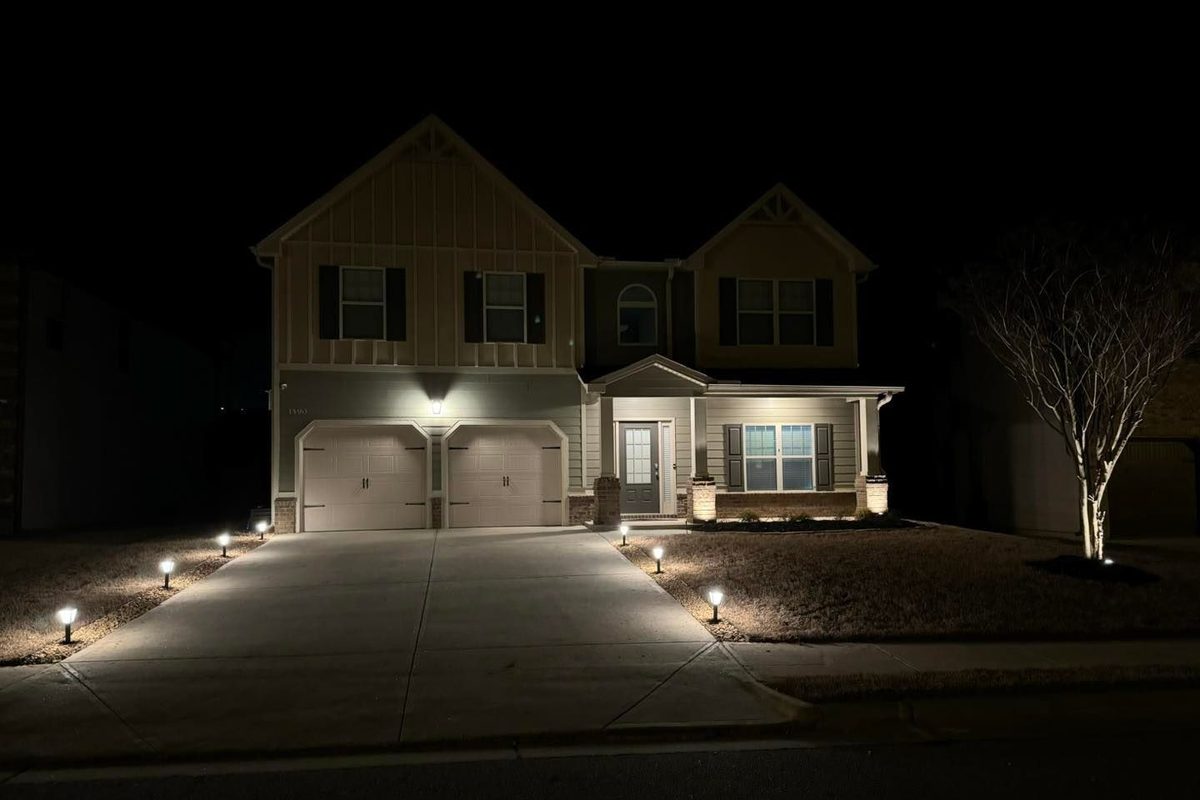
Grazing the architecture. Brick, stone and board-and-batten all take directional light well. A fixture close to the wall, aimed up, brings out the texture. The same fixture set back four feet just makes a bright patch.
Defining the approach. Path and step lights along walks, drives and stairs — spaced far enough apart to be light pools rather than a runway, and shielded so you see the path and not the bulb.
Filling the outdoor living space. Patios, decks, pergolas, outdoor kitchens and fire pit areas, lit warmly enough to be usable and dimly enough to still feel like being outside.
We schedule the design visit after dark wherever possible. In daylight you are guessing at what a tree will look like lit, where glare will land, and which sightline actually matters. At night it is obvious in ten minutes.
That visit also settles the practical questions: where the transformer goes, where cable can be trenched without cutting irrigation or roots, how many fixtures a run can carry before voltage drop makes the far end dimmer than the near end, and whether the existing exterior circuit can take it. Voltage drop is the most common defect in a system somebody else installed — the last three fixtures on a long run reading noticeably yellower than the first three.
The parts that determine whether a system still looks right in five years are unglamorous. Cable buried at a proper depth rather than tucked under pine straw where a rake will find it. Waterproof connections rather than twist caps in a box. Brass or well-finished fixtures where they will be walked past, because cheap fixtures in Georgia humidity go chalky. Fixtures set so that mulch top-up and shrub growth do not bury or block them by the second season.
Aiming gets revisited at the end of the job, at night, with the system on. That is a separate visit on some jobs and it is not optional — a fixture installed correctly and aimed roughly is a fixture that does nothing.
Included
Typical range: Quoted per property
Coverage
Questions
Often, yes. If you already have or are installing a permanent roofline system, landscape zones can frequently be brought onto the same schedule so the whole property comes on at dusk together. Where the systems stay separate, we set both schedules to match so you are not managing two apps with different ideas about sunset.
Doing both at once is also cheaper than doing them a year apart — one design visit, one trenching operation, one control conversation.
Less than most people expect. A front elevation with three well-aimed uplights on the best trees, texture on the primary wall material and a defined walk looks better than the same property with eighteen fixtures. Over-lighting is the commonest fault we are called out to correct, and correcting it usually means removing and re-aiming rather than adding.
Back gardens are the reverse: outdoor living areas tend to be under-lit for how much they are actually used.
It is if the runs are planned. Trenching for low-voltage cable is shallow, but it still crosses irrigation lines and root plates, and on a mature lot both are where you would rather not be improvising. We locate irrigation before cutting, route around structural roots rather than through them, and hand-dig inside the critical root zone of significant trees.
As long as they were designed to, and voltage drop is what decides it. Push too many fittings off one transformer, or run one leg too far on cable that is too thin, and the fittings at the end sit dimmer and warmer than the ones at the start.
People read that as failing fixtures. It is usually a design that was never delivering full voltage in the first place, and no replacement fitting fixes it.
The answers are decided at design: heavier cable on long legs, splitting load across multiple transformers, and hub wiring so no single leg carries too much. It costs a little more in material and it is the difference between a system that looks the same in year five and one that does not.
Georgia beds get topped up, and a fitting set at the right height in March can be half-buried by the following spring. It is the most common reason landscape lighting stops performing, and it has nothing to do with the equipment.
Setting fittings slightly proud, and telling whoever maintains the beds where they are, prevents most of it. So does using stems rather than sitting fittings flush in the mulch line.
Pollen season is the other one. A heavy spring coats lenses and cuts output noticeably, and a wipe restores it — worth knowing before assuming something has gone wrong.
Per property, quoted after the design walk. The drivers are fixture count, fixture quality, run lengths and how much trenching is involved — a courtyard is a different job from two acres with a lit drive. Because fixture count is the main lever, it is also easy to phase: front elevation this year, rear and patio next, on the same transformer if it was sized for it. We will size it for it if you tell us that is the plan.
Call (770) 630-4653 to arrange a night-time design walk.
Get in touch
Call and talk to someone who does the work, or send the details and we'll get back to you.
Call (770) 630-4653